
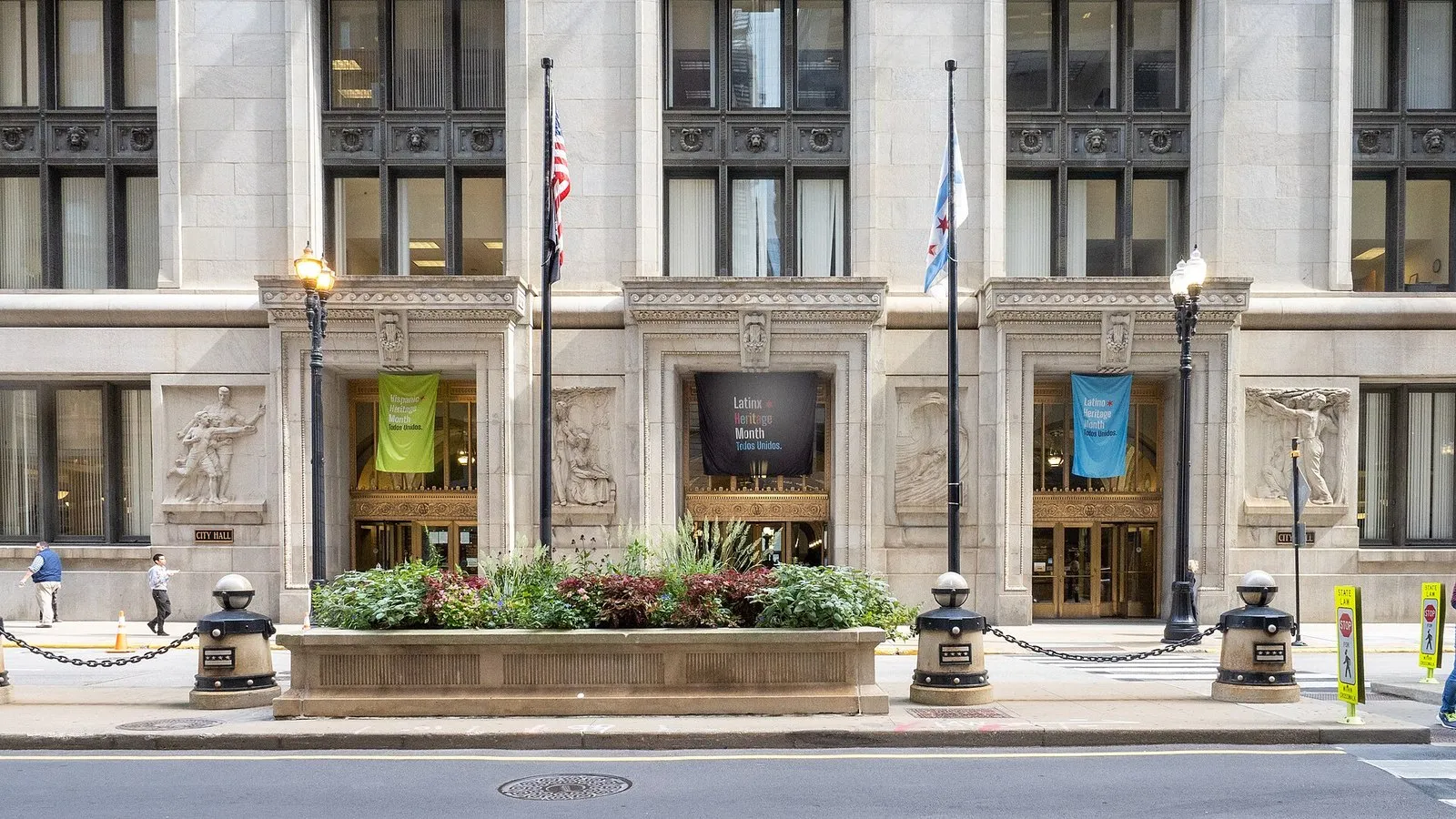
Chicago City Hall. Photo: ajay_suresh, CC BY 2.0, via Wikimedia Commons.
Chicago’s 2027 budget fight is back where it ended last year: a mayor who wants large employers to pay a per-worker tax and a City Council majority that says it won’t happen. For Uptown businesses, the outcome will decide which taxes go up in January and whether City Hall can get a budget done on time.
On Tuesday, the last day of the Council’s department-by-department budget hearings, 28 alderpeople sent Mayor Brandon Johnson a letter saying the votes for his $17.6 billion spending plan “do not exist,” WTTW News reported. Passing a budget takes 26 votes. The group, which calls itself the Budget Accountability Coalition, called the proposal “a non-starter.”
The taxes in question
The coalition rejected two of the mayor’s main revenue ideas.
The first is the head tax, formally the Chicago Employers’ Expense Tax. It would charge $25 a month for each Chicago-based full-time employee at companies with 125 or more workers, starting Jan. 1, according to the revenue ordinance summarized by Chicago Politics. Employers would get a credit for workers based mostly in federally designated disadvantaged areas, which cover much of the South and West sides. The mayor’s office expects it to raise about $100 million a year and says it would apply to about 2.8% of registered corporations, Block Club Chicago reported.
The second is an increase in the personal property lease transaction tax from 15% to 20%, worth about $234 million. That tax is added to car and equipment rentals and to cloud-based software. Johnson has framed it as a way to make big tech firms pay more, but it shows up on the bills of businesses of every size that lease equipment or pay for software subscriptions.
The coalition also said it would not back $131.5 million in new spending the mayor wants for a mental health clinic, 7,000 youth jobs and services for unhoused residents. It ruled out a property tax increase as well.
Where Uptown’s alderpeople have stood
Uptown is mostly in the 46th Ward, with parts in the 47th and 48th. In last year’s version of this fight, all three of the neighborhood’s alderpeople sided with the mayor. When the Council passed an alternative 2026 revenue package without his head tax on Dec. 19, 2025, by a 29-19 vote, Ald. Angela Clay (46th), Ald. Matt Martin (47th) and Ald. Leni Manaa-Hoppenworth (48th) voted no, according to the roll call compiled by Chicago Politics.
That vote does not settle how they will vote this year. The published reports on Tuesday’s letter did not list the full set of signers.
What happens next
Johnson answered the letter the same day. He told all 50 members his office was “developing new models” for both the head tax and the lease tax increase, but gave no details, according to WTTW. He also challenged critics to say what they would cut. The coalition’s position would open a hole of about $409 million in the mayor’s plan, and its members have not said how they would fill it.
Johnson has pointed to last week’s election for support. In nine precincts across four South and West side wards, about 88% of voters backed a nonbinding referendum calling for a tax on corporations with 500 or more employees to pay for youth jobs, mental health care and violence prevention. Three of the four alderpeople for those wards signed Tuesday’s letter anyway, Block Club reported.
The Council’s formal public hearing on the budget is set for Dec. 8, and a budget must pass by Dec. 31. City officials have said Chicago cannot pass a stopgap measure to keep government running. Without a deal, more than 30,000 city workers would go unpaid and city services would stop, according to WTTW.
Chicago had an employer head tax for four decades. It started in 1973 at $4 per employee per month for businesses with more than 50 workers, was cut to $2 in 2012 and was phased out by 2014 under former Mayor Rahm Emanuel. It brought in roughly $25 million a year. A WBEZ review cited by Block Club found no clear evidence that the tax or its repeal changed job numbers.
Most Uptown storefronts are far below the 125-employee line and would not owe the head tax. The lease tax and the timing of a final deal are the parts of this budget more likely to reach them directly.
Dana Ferraro covers property taxes, small business finance and the economy.