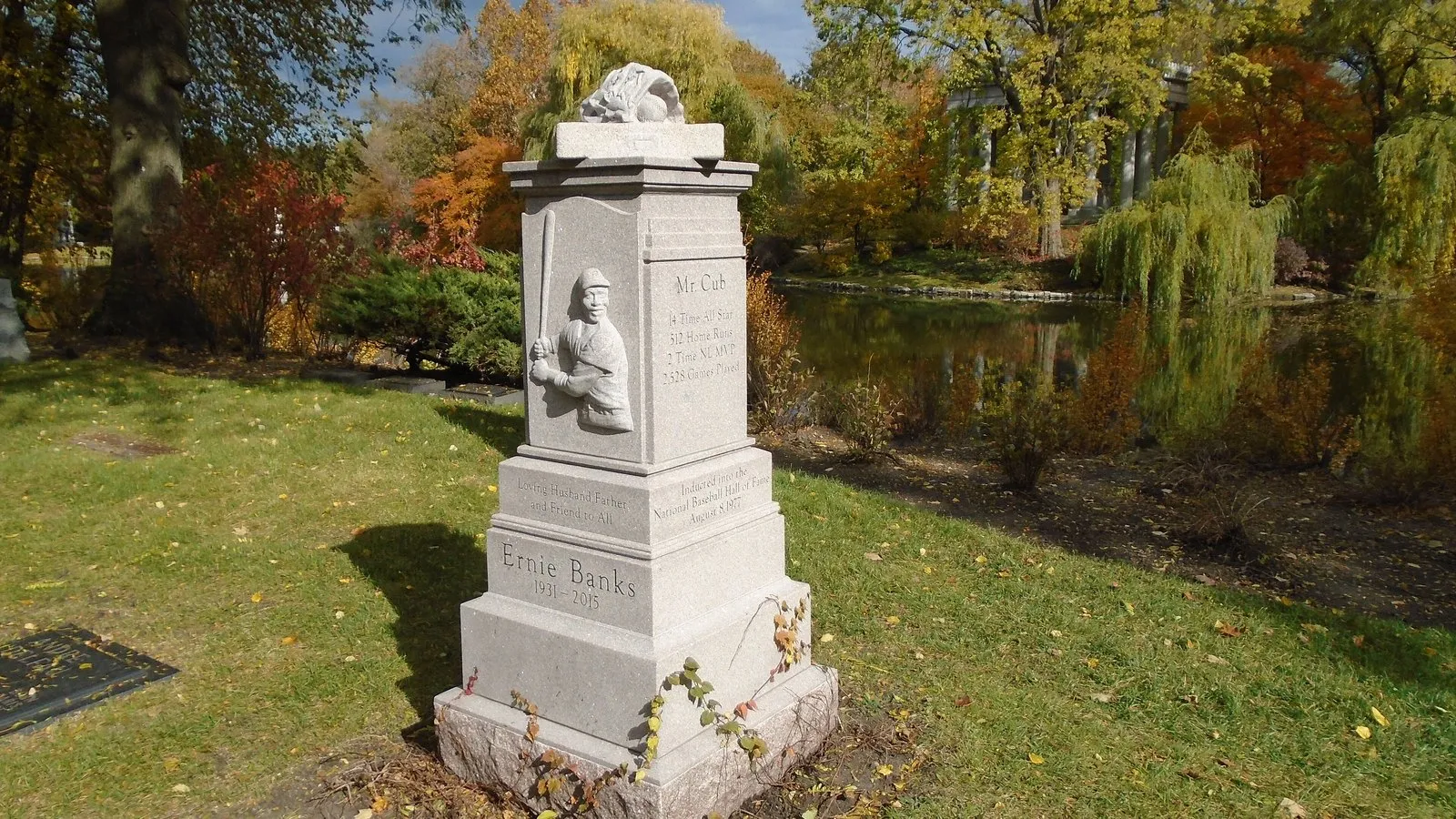
Ernie Banks' monument at Graceland Cemetery. Photo: Alanscottwalker / Wikimedia Commons, CC BY 4.0
Ernie Banks spent 19 seasons at Wrigley Field, and he is buried about half a mile north of it, just across Irving Park Road in Uptown. His grave at Graceland Cemetery, 4001 N. Clark St., shares the grounds with the man who founded the National League, the first Black heavyweight champion of the world and the player known as “Mr. White Sox.”
Graceland is best known as the “Cemetery of Architects,” the resting place of Louis Sullivan, Daniel Burnham and Ludwig Mies van der Rohe. But the cemetery’s own guide to its baseball and boxing greats points visitors to five graves that belong to sports history.
Mr. Cub
Banks played for the Cubs from 1953 to 1971. His debut on Sept. 17, 1953, was the first appearance by an African American player for the franchise, according to the National Baseball Hall of Fame. He had started with the Kansas City Monarchs of the Negro Leagues, who sold his contract to the Cubs. He won National League Most Valuable Player awards in 1958 and 1959, made 14 All-Star teams and on May 12, 1970, became the ninth player to reach 500 home runs. He was elected to the Hall in 1977 and received the Presidential Medal of Freedom in 2013. He died in Chicago on Jan. 23, 2015.
His monument carries a carved figure of a ballplayer and the words “Mr. Cub.”
The founder and the White Sox star
William Hulbert, who died in 1882, has a fitting marker: a large stone baseball. Hulbert became a stockholder in the Chicago White Stockings in 1870 and the club’s president in 1875, the cemetery says. In 1876 he organized the National League with eight teams, whose names are carved on the stone. The White Stockings won the league’s first championship, and their descendants are the Cubs. Hulbert was not inducted into the Hall of Fame until 1995.
Orestes “Minnie” Miñoso, born in Havana, played in Cuba and the Negro Leagues before his 1949 major league debut with Cleveland made him the American League’s first Afro-Latino player. Traded to the White Sox in 1951, he broke that club’s color barrier and went on to 13 All-Star selections and three Gold Gloves. The Sox retired his No. 9 in 1983, and he was inducted into the Hall of Fame in 2022, seven years after his death in 2015.
Two champions of the ring
Jack Johnson, 1878 to 1946, knocked out Tommy Burns in Australia in 1908 to become the first Black boxer to win the world heavyweight title. For years his grave was marked only by a large stone carrying his last name, the cemetery’s guide says, which left fans who came looking after Ken Burns’ 2005 documentary “Unforgivable Blackness” unsure they had found it.
Robert Fitzsimmons, 1863 to 1917, was born in Cornwall, grew up in New Zealand and became boxing’s first three-division world champion, at middleweight, light heavyweight and heavyweight. Boxing fans, including the Veterans Boxing Association of Illinois, replaced his original, misspelled headstone in 1973.
Visiting
Graceland was founded in 1860 by lawyer Thomas Bryan on land that sat two miles outside the city limits, in the town of Lake View, according to the cemetery’s history. It now covers 119 acres and is still an active cemetery run by a nonprofit trust. The gates are open every day of the year. Fall and winter hours are 8 a.m. to 4 p.m. on weekdays and 9 a.m. to 4 p.m. on weekends. The office is closed on Thanksgiving Day. The entrance is on Clark Street at Irving Park Road.
Graceland was one of the Uptown stops in this year’s Open House Chicago. For more Uptown history, see our stories on Chaplin and Gloria Swanson on Argyle Street, the Riviera’s beginnings and the Sheridan Trust banks at Broadway and Lawrence, and more profiles on our People page.
Ruth Kaminski is the editor of The Uptown Ledger and covers neighborhood institutions and housing.