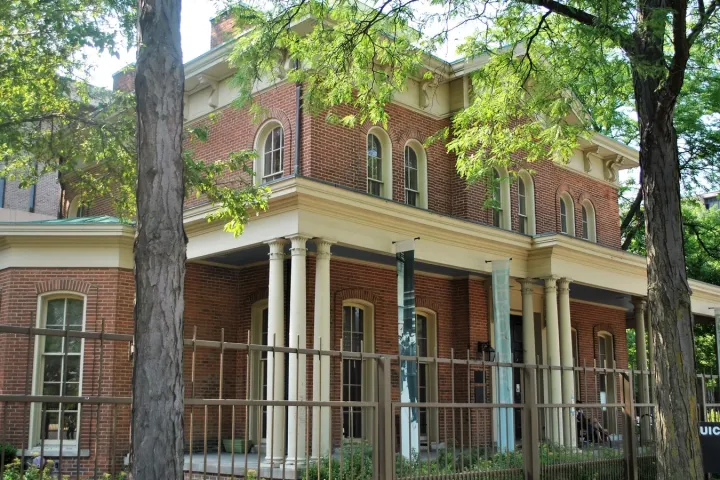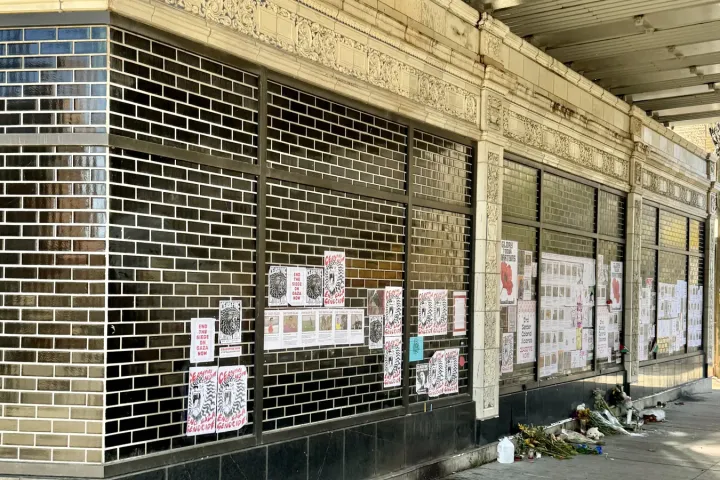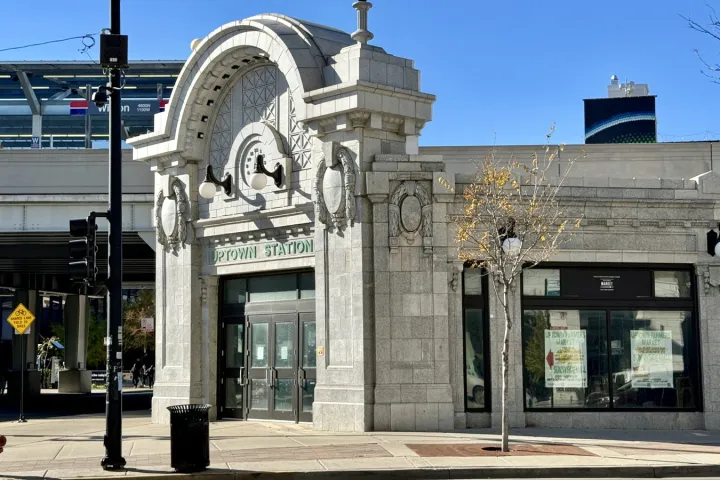
The former Uptown National Bank Building, built in 1924 for Sheridan Trust and Savings Bank, at Broadway and Lawrence. Photo: Warren LeMay / Wikimedia Commons, CC BY-SA 4.0
Two buildings at Broadway and Lawrence carry the same bank’s story. Sheridan Trust and Savings Bank put up the first one in 1915 and the second, much larger one in 1924. Seven years after that, the bank failed.
The account comes from the Commission on Chicago Landmarks’ 2016 report on the Uptown Square District, which traces how the blocks around the intersection grew into one of the city’s busiest shopping and entertainment centers outside the Loop. Both bank buildings are listed in the report as contributing buildings to the district.
A flatiron bank at a trolley transfer point
W. J. Klingenberg founded Sheridan Trust and Savings Bank in 1909 at the corner of Wilson and Broadway, according to the report. In 1915 the bank moved into a new building at 4728 N. Broadway, on the triangular block formed by Broadway, Leland and Racine, facing the Lawrence and Broadway intersection.
The site set the shape. The report describes the building as a “flatiron,” a form that was popular for office and bank buildings of the period. The architects were Huehl, Schmid and Holmes, and the design was Classical Revival, with a pedimented corner and very large arched windows. The report says the building gave “a visual anchor for an intersection that had become one of the city’s busiest trolley transfer points.”
Next door, at 4720 N. Broadway, Loren Miller opened a department store the same year. Miller had been a department manager at Marshall Field’s, and his five-story, terra cotta-clad store offered 26 departments. The report quotes a 1921 Women’s Wear Daily article crediting Miller with “taking away another million dollars’ worth of business from Chicago’s famous State Street.”
The 1924 tower across Broadway
By the early 1920s the bank had outgrown the flatiron. In 1924 it built an eight-story bank building at 4753 N. Broadway, at the southeast corner of the Broadway and Lawrence intersection, the report says. When the bank moved, the Loren Miller store took over the 1915 building at 4728 N. Broadway.
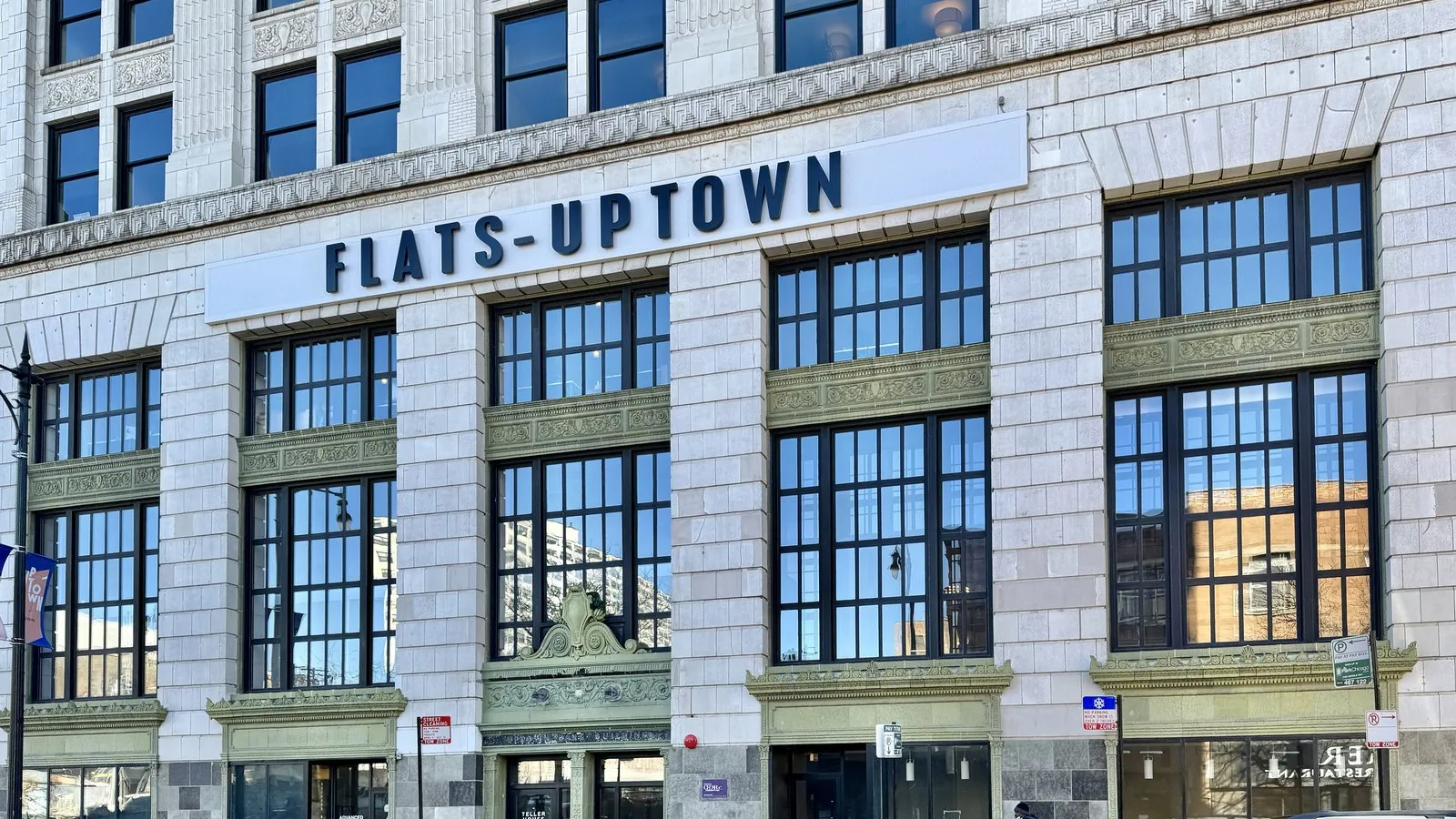
The new building was designed by Marshall and Fox, the firm behind the Blackstone Hotel and the Drake Hotel. It was the firm’s second major building in the district after the McJunkin Building at Wilson and Broadway. Inside, the report says, a mezzanine-level banking hall “rivaled its downtown counterparts for elaborateness,” with a double-height, coffered plaster ceiling imported from Italy.
The building was planned so it could grow. Four years later, in 1928, a four-story addition went on top. The architects for the addition were Huszagh and Hill, a local firm known mostly for houses and apartment buildings. The same firm worked on the Aragon Ballroom, the Wilton Hotel and the New Lawrence Hotel, and the report calls their Uptown buildings “the best collection of their work in Chicago.”
Failure in 1931, then decades as Uptown National Bank
The expansion did not last long for the bank that paid for it. “In 1931, the Sheridan Trust & Savings Bank failed,” the report says, “and by 1937 the building had been taken over by the Uptown National Bank, which remained in the space until 2003.”
The building was designated an individual Chicago Landmark in 2008. Today its Broadway facade carries a Flats-Uptown sign above the tall windows of the old banking floor.
The report also notes that the Uptown National Bank building and the Loren Miller building had both gone through extensive rehabilitation in the years before it was written, while the Plymouth Hotel, one of the district’s first hotels, was demolished in 2003.
Why the corner mattered to banks
The report places the two bank buildings in a larger pattern. Between 1915 and 1926, it says, about two dozen major business centers grew up in Chicago neighborhoods outside the Loop, usually at transit transfer points. Storefronts there cost less than downtown, and residents could “shop, bank, and see movies and live shows without leaving their neighborhood.” A city directory of the time called such centers “miniature Chicago’s.”
Uptown was one of the largest of them, the report says, and had the biggest concentration of entertainment venues. The 1915 flatiron sits right next to the Riviera Theatre, and both bank buildings are a short walk from the Uptown Theatre, which the city’s TIF forecast now lists for future funding.
For readers who want to go further, the Chicago Public Library’s Northside neighborhood collection holds much of the area’s paper record, as we wrote in our piece on the library archive. More coverage of Broadway buildings is in our Real Estate section, including our block-by-block look at empty storefronts on Broadway.