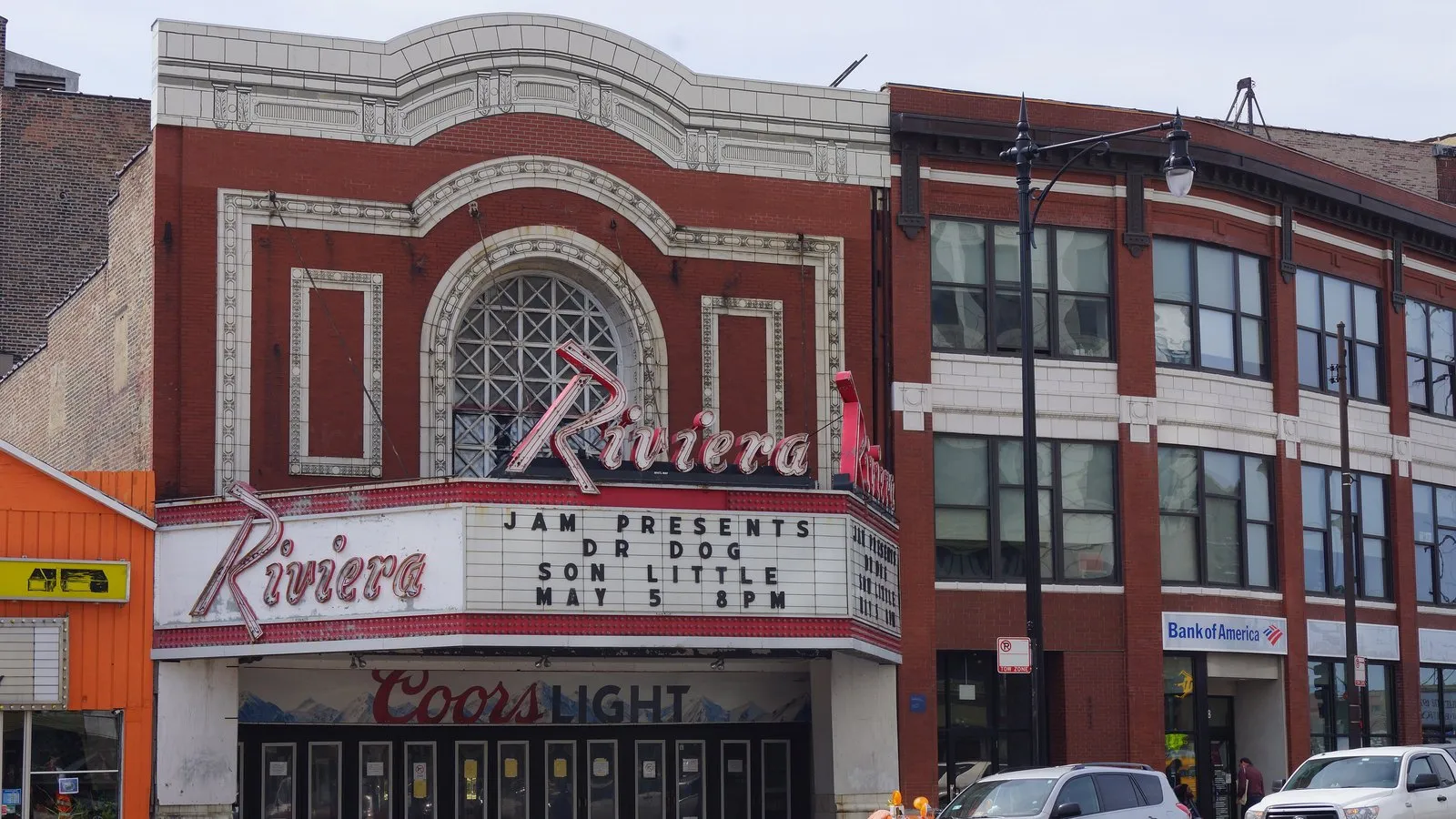
The Riviera Theatre and its adjoining commercial block in Uptown. Photo: Goldnpuppy / Wikimedia Commons, CC BY-SA 4.0
The Riviera began as someone else’s theater. The Chamales brothers, the family behind the Green Mill, were putting up a movie house at Lawrence and Racine during World War I when money ran short, and they sold the nearly finished shell to a young theater company called Balaban and Katz.
That sale, described in the city’s Uptown Square District landmark designation report, helped set the course of Chicago’s movie palace era. The Riviera was the second theater Balaban and Katz opened in Chicago and the second one the architects Cornelius W. and George L. Rapp designed for the company. It did well enough that Balaban and Katz used Rapp & Rapp almost exclusively from then on, a partnership that produced the Chicago Theatre, the Tivoli and, a few blocks away, the Uptown Theatre.
More than a century later, the Riviera is still a working stage, one of the reasons concert nights remain a pillar of the Lawrence Avenue economy.
A theater with a business block attached
The landmark report dates the building to 1917, from Rapp & Rapp’s plans, and the theater opened the following year. It was built as a complex rather than a single hall. The Riviera held about 2,500 seats, and the adjoining three-story commercial building held offices, retail stores, a billiard hall and restaurants. The report says the theater featured a 30-piece orchestra, with specialty acts staged between features.
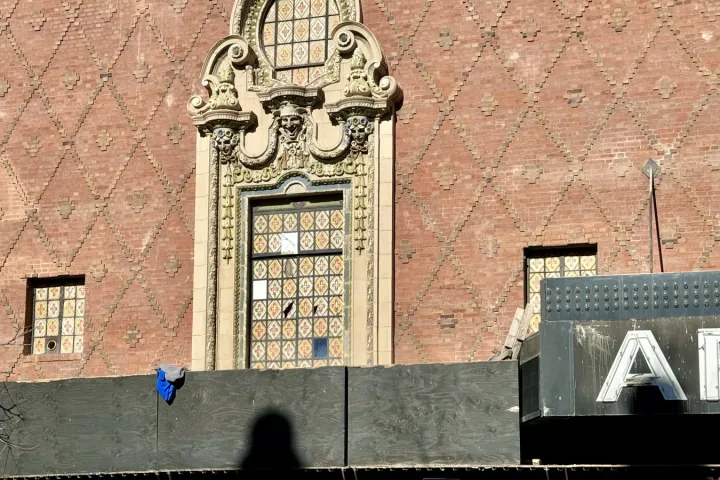
That mix of uses is still visible from the sidewalk. The arched, terra cotta-trimmed theater front sits beside a brick commercial block, which the report singles out as an example of restoration work in the district in the decade before its 2016 designation.
The Riviera arrived as Uptown was becoming the city’s busiest entertainment district outside the Loop. By 1924, according to newspaper accounts cited in the report, there were nearly two dozen movie theaters in and around Uptown with a combined seating capacity of almost 25,000, the highest ratio of theater seats to residents anywhere in Chicago beyond downtown. Their gross receipts were said to reach $50 million a year.
From movie house to music room
The Riviera was not Uptown’s true palace. That title went to the Uptown Theatre, which opened in 1925 with 4,381 seats. But the Riviera outlasted much of what came after it. When crowds thinned in the decades after World War II, the report notes, “far fewer came to see movies at the Uptown, Riviera, and Lakeside.” The Uptown Theatre closed in 1981, while the Riviera and the Aragon Ballroom found a second life as live music venues, which is how most Chicagoans know them now.
That second life has kept people coming to the corner. Show nights at the Riviera and the Aragon fill nearby bars and restaurants, and the Green Mill, where the Chamales family’s story in Uptown began, still draws its own crowd across Broadway.
What the landmark status means
The Uptown Square District received its final Chicago Landmark designation on Oct. 6, 2016. The district takes in portions of Lawrence Avenue, Broadway and nearby streets, and the report’s building inventory lists the Riviera as a contributing building in the Classical Revival style. The report says the district is “extraordinary for the quantity, variety, and flamboyant nature of decorative terra cotta employed in its buildings,” and the Riviera’s facade is one of the examples.
Designation as a Chicago Landmark protects buildings by law, the report explains, and building permits in the district come under review by the Commission on Chicago Landmarks, the nine-member body appointed by the mayor and City Council. Owners can ask the commission, case by case during that permit review, to decide whether a given building counts as contributing.
That question is now being worked out a block away, where the city’s TIF projections set aside $13 million for the long-dark Uptown Theatre in 2028, part of a restoration now priced at $200 million. The Riviera is the reminder of what a Rapp & Rapp house on that corner can do when it stays open.
For more on Uptown’s stages and the history behind them, including the Essanay studio on Argyle Street, see our Arts & Nightlife coverage.