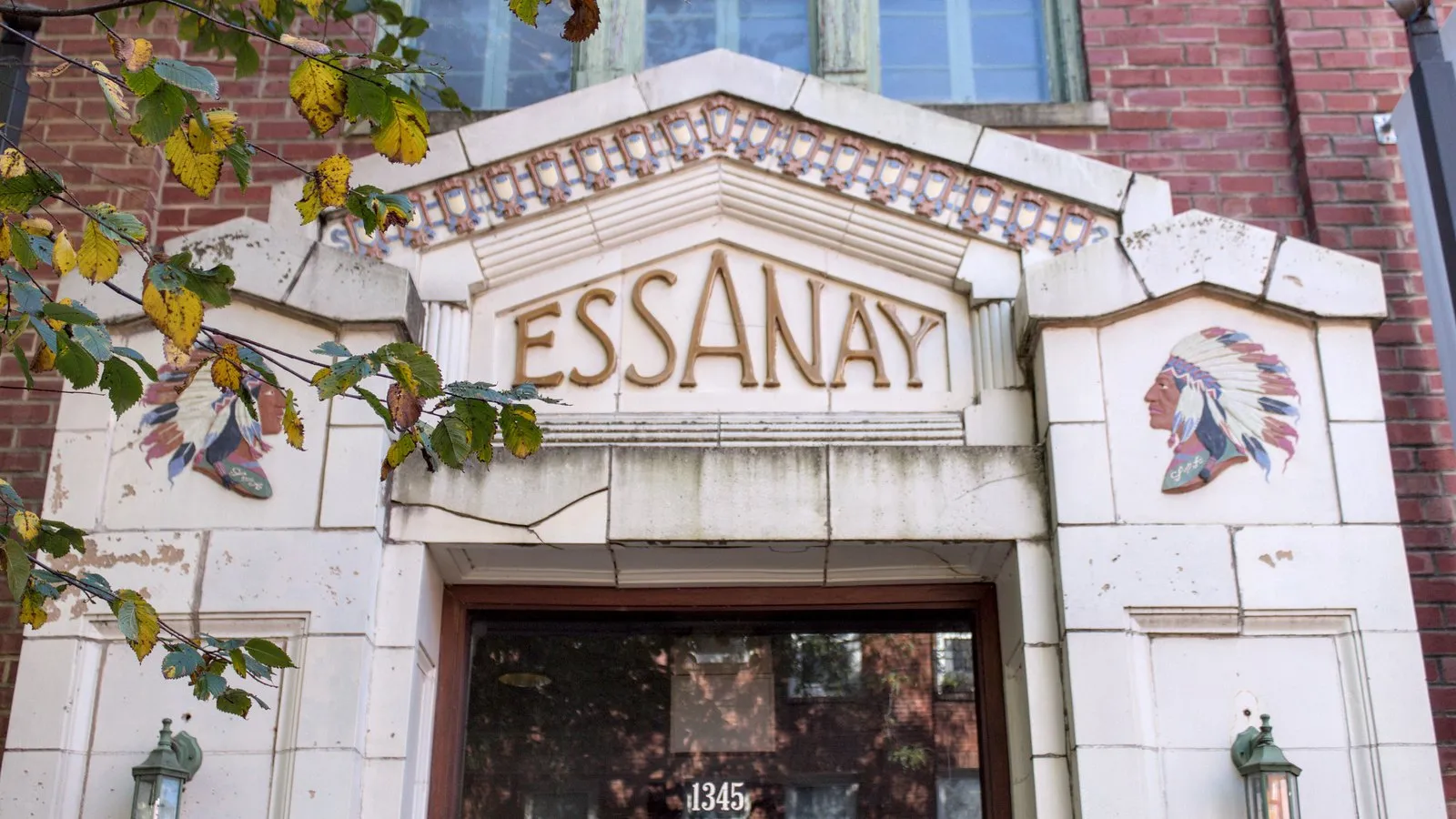
The Essanay Studios entrance at 1345 W. Argyle St. Photo: Dan Leonard / Wikimedia Commons, CC0
At first glance, most of the 1300 block of West Argyle Street looks like a row of old brick industrial buildings. The giveaway is the doorway at 1345: a white terra-cotta entrance with the word ESSANAY across the top and a feathered Indian head profile on each side. That was the trademark of Essanay Studios, which for a decade was one of the busiest movie companies in the country, and some of the first American film stars went to work there.
The city’s landmark report on Essanay Studios, prepared in 1989 and reprinted in 1996, lays out who passed through the buildings at 1333-45 W. Argyle St. between 1907 and 1917. The Commission on Chicago Landmarks used it to recommend the complex, and the city designated it a Chicago Landmark on March 26, 1996.
Spoor and Anderson, S and A
The company was the work of two men. George Spoor (1871-1953) ran a national film distribution business out of Chicago. Gilbert M. Anderson (1882-1971), born Max Aronson, knew production from the camera up. They formed a partnership in April 1907, and the name came from their initials: S and A.
Anderson became the movies’ first cowboy hero. He played “Bronco Billy” in a series that ran to almost 400 films over his career, according to the report. After shooting westerns in Boulder and Golden, Colorado, he set up the Essanay Western Company at Niles Canyon, California, where many of them were made. Spoor handled the business side and the technical side. Construction of the Argyle Street buildings began in November 1908, with additions through 1915, and the complex held three large studios along with a carpentry shop, prop and wardrobe storage, dressing rooms, film processing and storage vaults, and offices. The city lists Jeremiah J. Cerny as the architect.
The people who started there
Essanay pushed its actors as personalities, and the report credits the company with helping invent the idea of the movie star. Several of the names it built are still familiar.
Gloria Swanson, a Chicago native, was “discovered” while touring the studio with her aunt, the report says. She started as a studio receptionist and film extra, and in her earliest pictures she worked as an extra alongside the writer Katherine Anne Porter. A photo reproduced in the report shows Swanson cranking a camera on location around 1915, with her husband, actor Wallace Beery, beside her.
Francis X. Bushman joined Essanay in 1911 and quickly became the leading male screen idol of his day. Beverly Bayne was a 16-year-old Hyde Park High School student when she made her first Essanay film; within two years, the report says, hers was one of the most recognized faces in the country. Wallace Beery also began his career at the studio.
Ben Turpin started at Essanay as a janitor and office boy and starred in the company’s first film, a comedy in which he played a wild roller skater. The scripts came from writers including Ring Lardner, and the scenario department was run by Louella Parsons, who went on to become one of the best-known film columnists in the country.
Chaplin’s one Chicago picture
The biggest name of all stayed only briefly. Anderson lured Charlie Chaplin away from Mack Sennett’s company in December 1914 for what the report calls the “unheard-of sum of $1,250 per week.” Chaplin did not care for Chicago or its weather, and he made only one movie at the Argyle Street studio, His New Job, in 1915. Turpin appeared with him for the first time in that film, and Swanson played a receptionist. Chaplin made the rest of his Essanay films at the company’s Niles Canyon studio in California and left after a year for the Mutual Company.
That loss marked the beginning of the end. Anderson sold his shares to Spoor in 1915, the same year a federal court ordered the film patent trust formed by Essanay, Thomas Edison’s company and the other major producers to disband. With the industry moving to California and star salaries rising, Essanay shut down in 1917.
What happened to the buildings
The studio was sold in 1917 to Wilding Pictures, a subsidiary of Bell & Howell, the company founded by two of Spoor’s former employees, and the buildings stayed in film use by other companies into the mid-1970s. In 1973 the company donated the complex to WTTW, and the report notes that St. Augustine College later acquired the buildings.
The doorway is the easiest piece to see from the sidewalk, and it is about two blocks from the Argyle Red Line station. It is part of a run of Uptown entertainment history that includes the Uptown Theatre and the stages along Broadway, where TimeLine just marked its 100th show. For more of the neighborhood’s landmark buildings, see our rundown of Open House Chicago’s Uptown sites and the rest of our People coverage.
Joel Sandoval covers arts, music venues and nightlife.